A small chip on your motorcycle’s tank or fairing can stand out on an otherwise beautiful bike. Before choosing touch-up paint, find the correct motorcycle paint color code and confirm which painted part you want to repair. A color name or an online photo is a starting point, but neither confirms the right formula on its own.
Start with the color or model label described in your owner’s manual. On some motorcycles it is under the rider or passenger seat. If the label is missing, unclear, or identifies only a color scheme, ask an authorized dealer to confirm the original color using your VIN, model year, market, and the specific panel. There is no universal paint-code location for every motorcycle.
How to find your motorcycle paint color code in 5 steps
1. Identify your motorcycle and the part you are repairing
Write down the make, exact model, model year, and country or market specification. Use the model year rather than assuming the registration year is the same. Then identify the damaged part: fuel tank, front fender, fairing, side cover, wheel, or frame.
A motorcycle can have several factory finishes. The tank’s blue may be different from the wheel’s blue, and a black frame may have a different sheen from a black body panel. Match the paint to the part, not just the overall appearance of the bike.
2. Check your owner’s manual before searching the bike
Look for headings such as “Color Label,” “Colour Label,” “Model Label,” “Identification Numbers,” or “Consumer Information.” The manual can show the label location and explain how to access it. Some labels identify a model or color combination rather than a ready-to-order paint formula.
3. Inspect the label location shown for your model
If your manual places the label beneath a seat, follow its seat-removal instructions. Photograph the complete label in good light before copying any code. Keep letters, numbers, hyphens, and suffixes exactly as printed. Check ambiguous characters such as O and 0 or I and 1 against the original photo.

4. Confirm the paint code and finish
Record the full factory color name and ask whether the identifier refers to an individual paint color, an overall color scheme, or a colored replacement part. If you cannot tell, take the label photo to your dealer. Confirm whether the damaged surface is gloss, satin, or matte and whether the color uses multiple layers.
5. Match the listing and test before application
Compare the motorcycle manufacturer, complete paint code, color description, intended part, and finish with the product listing. Once your paint arrives, make a small sample on a separate test surface, let it dry as directed, and compare it with your bike in daylight. Follow the instructions for that specific color and paint system.
Where to find motorcycle paint codes by brand
Use this table to choose your next step. It is a guide to identification methods, not a promise that every motorcycle from a brand has a sticker in the same place.
| Brand | Where to start | What to confirm |
|---|---|---|
| Honda | Your manual’s color-label section. Some models, including the 2005 VFR800, place it on the frame under the seat. | The complete color code and any color-scheme or part-color references. |
| Yamaha | The model-label location in your manual. The 2021 Tracer 9 GT manual places it under the rider seat. | Use the full label information with a dealer or parts catalog; do not treat every model-label field as a paint formula. |
| Kawasaki | The official parts catalog and your dealer for the exact model and market. | The overall color combination versus the color of the particular component. |
| Suzuki | Model-year color information, service records, and the correct painted-part listing through a dealer. | The factory color reference for the tank, fairing, or other part being repaired. |
| Harley-Davidson | VIN-based identification through a dealer and model-year parts information. | Color option, individual color suffix, and the specific painted part. |
| BMW Motorrad, Ducati, Triumph, KTM, and other makes | Your model’s manual, original purchase records, or an authorized dealer with the VIN. | The manufacturer’s exact color reference and finish for the damaged component. |
Honda: look for the color label, then verify the scheme
Honda’s motorcycle parts guidance explains that label positions differ by model and a color label is not always fitted. Its parts catalogs also distinguish the color label from the color variation used for a replacement part. Start with your own manual and record the whole label. Honda’s official parts-identification guide explains the process; the VFR800 owner’s manual provides a specific under-seat example.
Yamaha: the model label helps identify the right version
The 2021 Tracer 9 GT owner’s manual locates its model label on the frame under the rider seat and says that information is needed when ordering spare parts. Photograph the entire label and ask your dealer to identify the corresponding color for the panel. Check your own manual because another model may use a different location.
Kawasaki: distinguish the motorcycle’s scheme from its parts
Kawasaki’s official Japan-market FAQ directs owners to its parts catalog for proprietary vehicle and individual-part color codes. Its US support FAQ instead directs color-matched-paint inquiries to a paint supplier. Availability and identification routes can differ by market. Your dealer can help interpret the reference for your bike.
Suzuki and Harley-Davidson: use the full factory reference
Suzuki’s official GSX-S1000 model information pairs named colors with references such as YSF. This shows why recording both the name and code is useful; it does not establish the color of an individual motorcycle.
Harley-Davidson’s 2025 Touring parts information lists color option codes and color suffixes separately. Have the dealer confirm the appropriate reference for the damaged part rather than assuming a model code or option code is a universal paint-mixing code.
Paint code, VIN, model code, and color name: what is the difference?
- Paint or color code: a manufacturer’s color reference. Confirm how the paint listing uses it.
- VIN: identifies the motorcycle and can help a dealer find its original specification.
- Model code: identifies a model or version; it is not automatically a paint code.
- Color-scheme code: may identify a combination of colors used across the bike.
- Painted-part number: orders a component; its suffix may identify a color variation without being a standalone mixing formula.
- Color name: a useful description that still needs the correct manufacturer and code.
What to save
Make + model year + full code + color name + specific panel + finishKeep a photo of the original label or a written dealer confirmation with your notes. Copy the complete reference instead of shortening it.
Can you find motorcycle paint color by VIN?
A dealer may be able to use the VIN to retrieve the motorcycle’s original build or parts information. That does not mean the VIN visibly contains a paint code or that every public VIN decoder returns the right color.
Ask: “Can you confirm the original factory color name and paint reference for this motorcycle’s fuel tank, including whether it is a multilayer finish?” Replace “fuel tank” with the part you are repairing. If the panel has been replaced or repainted, the original build information may no longer describe its current finish.
Two-tone, pearl, candy, and matte motorcycle paint
Getting the color reference right is one part of the match. The finish and application system matter too.

- Two-tone paint: identify the exact color in the damaged area. A single scheme can contain multiple colors.
- Metallic or pearl: appearance changes with light and viewing angle. Compare a dried sample from more than one angle.
- Candy or multilayer colors: the specified layers and application affect the appearance. Check the listing’s requirements rather than assuming every color is a single-step repair.
- Matte or satin: confirm the intended sheen. A gloss touch-up can remain visible even when the hue is close.
- Decals and graphics: establish whether the mark is in paint or a graphic. Touch-up paint does not recreate a printed design.
What if the paint-code label is missing or the motorcycle was repainted?
Start with the manual, service book, original invoice, and any records from the previous owner. Then ask a dealer to check the original specification. For a custom-painted motorcycle, ask the painter for the paint manufacturer, formula, and finish.
If the current coating cannot be identified, a refinishing specialist may be able to assess a physical sample or panel. A phone photo and a familiar color name are not enough to establish an exact match. Online swatches are useful for browsing, but screens, lighting, and photography can change the appearance.
Before buying motorcycle touch-up paint
- Confirm the motorcycle make and complete color reference.
- Check that the listing describes the correct panel and finish.
- Read any layering or application requirements.
- Choose a small-area repair product for small chips and minor scratches.
- Plan to test the dried paint before applying it to the bike.
A touch-up can make small damage less noticeable. A deep gouge, damaged panel, or large refinishing area may need additional preparation or professional repair.
Motorcycle paint-code questions
Is the motorcycle paint code always under the seat?
No. Some models have a color or model label there, but label placement and the information supplied vary. Check the owner’s manual for the exact motorcycle.
Can I choose motorcycle touch-up paint by color name alone?
A name can help narrow the search, but confirm the manufacturer, full color reference, part, and finish before ordering.
Does the tank use the same paint as the wheels or frame?
Do not assume so. Confirm the color and finish for each component, even when the parts look similar.
Will the original paint code match a repainted motorcycle?
Only if the repaint used the same relevant formula and finish. Check the repaint records or consult the painter before choosing factory-code paint.
Does TouchUpPaintX offer a motorcycle VIN lookup?
Our store uses catalog search by manufacturer and paint code. Confirm your code using your motorcycle’s documentation or dealer, then search the catalog and check the listing for an appropriate match.
Small tool. Big difference.
Your next step: confirm your code, then choose your color.
Bring a little care back to the bike you love. Search the TouchUpPaintX catalog for your confirmed manufacturer and paint code, and choose a listing that matches your repair.
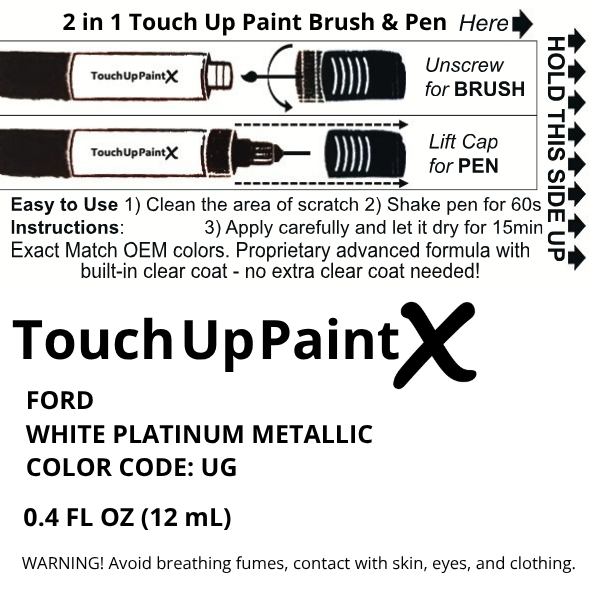
2-in-1 pen and brush · $14.99 USD · Free USA shipping
Ships within 2 business days via USPS Ground Advantage.
Looking for a car paint code? Read our car paint-code guide.