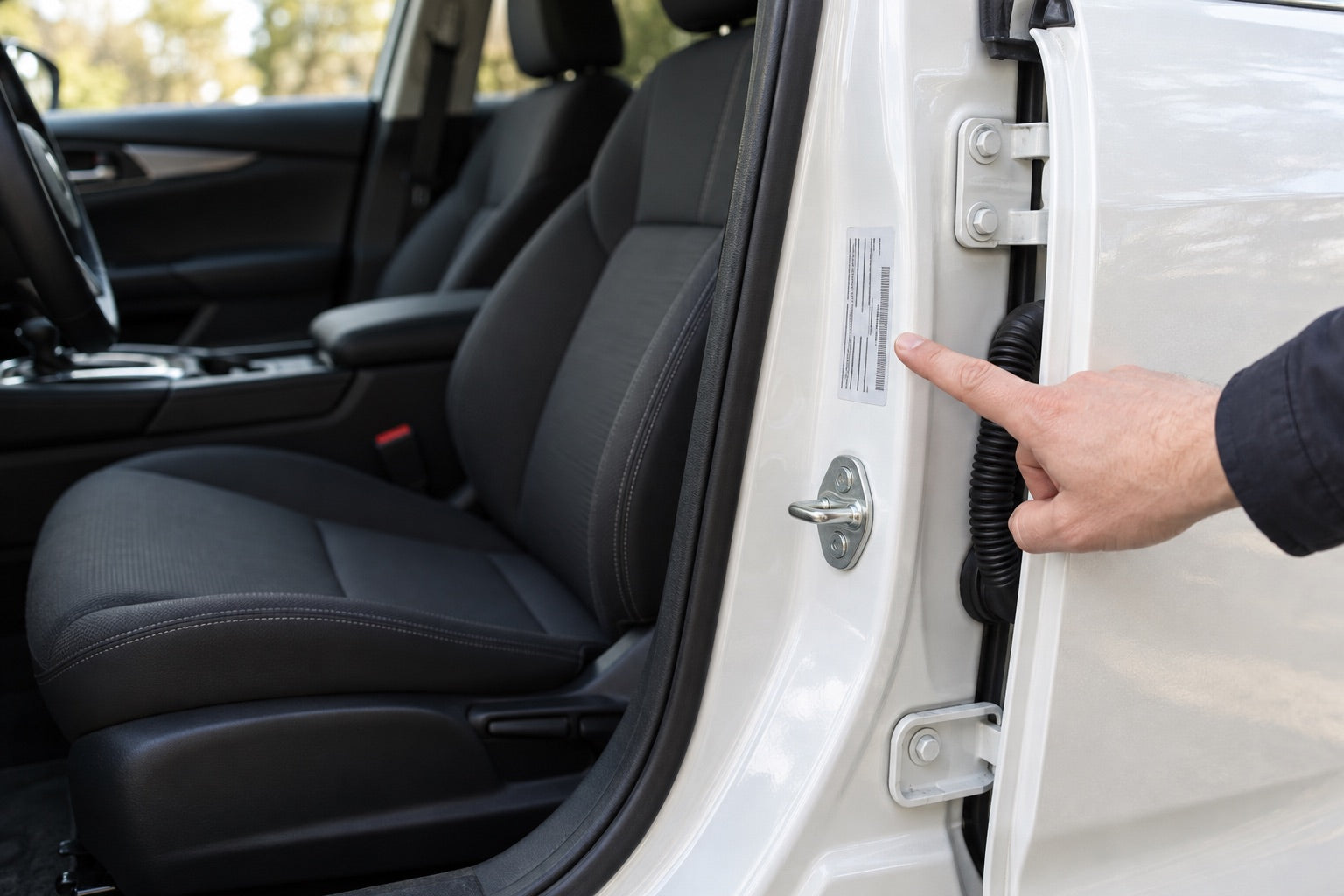
To find your car’s paint color code, start with the manufacturer label around the driver’s door. Open the door and check its edge and the door frame, also called the door jamb. Look for the exterior paint or color field. The location and label wording vary by vehicle, so use the brand guide below if you cannot find it.
Before ordering touch-up paint for a chip or scratch, confirm the code on your own vehicle. “White,” “silver,” or even a familiar factory color name may not give you enough information to select the right paint.
How to Find Your Car Paint Code in 3 Steps
1. Find the manufacturer’s paint label
Check the driver’s door edge and the frame it closes against. A paint code may appear on a vehicle information sticker alongside other details. Dupli-Color’s paint-code guidance identifies the driver’s door jamb as the most likely starting point.
If you only see tire pressures or vehicle weights, keep looking: not every sticker identifies the paint. Some vehicles use a separate plate or a label elsewhere. Check the brand table, then your model’s owner’s manual or dealer guidance.
2. Identify the exterior color field
Look for wording such as PAINT, COLOR, EXT PNT, or C/TR. The paint code is usually a short sequence of letters, numbers, or both. Nearby trim, model, and production codes can look similar, so copy the value from the correct field rather than the first short code you see.
3. Photograph it and copy the complete code
Take one clear photo of the whole label and another close-up of the paint field. Keep leading zeros, letters, and any suffix that belongs to the exterior code. Write down your vehicle’s make, model, and year too. These details make it easier to check a product listing before you order.
Where to Find Paint Codes by Vehicle Brand
Use these locations as starting points. Labels can change by model year, market, and vehicle—not every car from the same manufacturer uses the same position.
| Vehicle brand | Where to start | Helpful detail |
|---|---|---|
| Ford / Lincoln | Driver’s door edge or door jamb. | Look for EXT PNT, separate from INT TR. |
| Toyota / Lexus | Driver’s door edge or pillar. | C/TR may combine color and interior trim information. |
| Honda / Acura | Driver-side center pillar in the door opening. | Copy the complete exterior color code. |
| Hyundai / Genesis | Driver-side center pillar. | Locate the exterior paint field. |
| BMW / MINI | Under the hood on models using an engine-bay paint label. | Confirm the location for your year and model. |
| Volkswagen / Audi | Rear luggage compartment or spare-wheel well on models with a vehicle data sticker. | Ask your dealer if no sticker is present. |
| Chevrolet / GMC / Buick / Cadillac | Certification label or older Service Parts Identification label. | Some newer labels use a QR code. |
| Tesla | Driver-side door label on vehicles covered by Tesla’s repair-kit guidance. | Older Roadsters use a different location. |
The Sherwin-Williams 2017 Global Color Manual documents the Toyota/Lexus, Honda/Acura, Hyundai/Genesis, BMW/MINI, and Volkswagen/Audi locations above for that model-year guide. Treat it as a reference for those vehicles, not proof of the location on every newer model. Rust-Oleum’s Ford identification guide shows the driver’s door edge and pillar locations.
Finding a GM paint code on a QR label
GM introduced QR codes on certification labels beginning with the 2018 model year. GM’s technical guidance explains that the scanned information includes the paint code; older Service Parts Identification labels were often in the glove box or trunk. If scanning produces a long string of information, have your dealer identify the exterior paint value before ordering. See GM TechLink’s certification-label guide (Spanish).
Finding a Tesla paint code
Tesla’s paint repair guidance directs owners to the label attached to the driver-side door. There are exceptions: the original Roadster service manual places its paint-code label beneath the dashboard. Always use guidance for your specific model.
How to Read a Paint Color Label Without Mixing Up the Codes
The important distinction is exterior paint versus interior trim. Both may be printed on the same sticker, but they identify different finishes.
- Ford example: EXT PNT identifies exterior paint; INT TR refers to interior trim. These appear as separate fields on Ford’s example certification labels.
-
Toyota example: a label reading
C/TR 3P1 FA09uses3P1for the exterior paint.FA09is the interior option code, according to PaintScratch’s Toyota label explanation. - VIN: the vehicle identification number identifies the vehicle. Do not enter the full VIN into a field asking for a paint code.
These examples show how to read a label; they are not recommendations for your car. Order using the information confirmed on your own vehicle.
What If Your Paint Code Sticker Is Missing or Unreadable?
Contact your vehicle dealer’s parts department with your VIN, make, model, and year. Ask them to confirm the original exterior paint code and, if relevant, the code for the particular panel or accent you want to repair. Ford’s manufacturer guidance recommends contacting a dealer to obtain a paint code.
A dealer may use your VIN to retrieve the original build information. That is different from assuming a general VIN decoder has identified your paint. Ask for the confirmed code, rather than relying only on a color name returned by a lookup.
If the car has been repainted, tell the dealer or paint professional. Factory records describe the original finish and may not identify the paint currently on a repaired or refinished panel.
You Found Your Code. How Do You Choose Touch-Up Paint?
Before adding a product to your cart, check:
- Vehicle make: use the make together with the paint code.
- Complete code: compare your label with the product description, including relevant letters and zeros.
- Repair area: confirm whether you need body, roof, accent, or wheel paint.
- Paint system: read the color-specific application instructions before starting.
A confirmed OEM code is the starting point for color selection. It does not guarantee that every finish will look identical after application. PPG’s professional color-matching guidance discusses selecting variants within the same color code. Test your touch-up paint on a separate surface, let it dry as directed, and compare it before applying it to your vehicle.
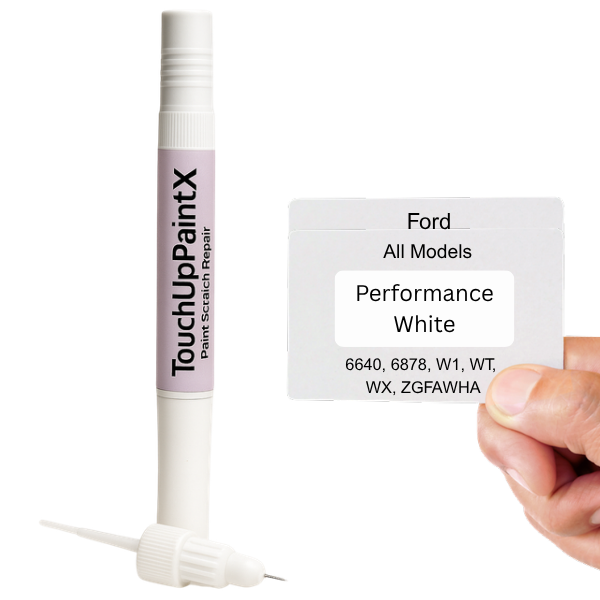
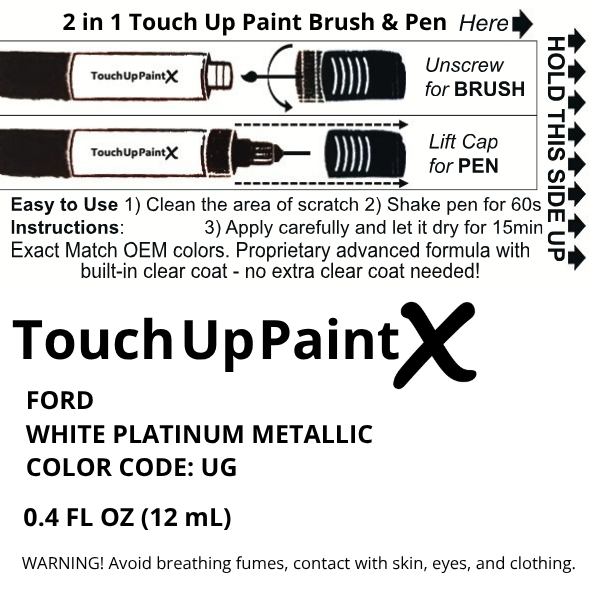
For small chips and minor scratches, TouchUpPaintX combines a precision pen tip and a brush in one tool. Our touch-up paint is made in USA and matched using OEM paint codes.
Ready to check your color? Buy My Color: enter your vehicle make and confirmed paint code to search our catalog. Open the matching product and verify its code before checkout. If no match appears, confirm availability before ordering a different code.
Car Paint Code FAQs
Is my paint code the same as the color name?
No. The name describes the color; the code is the identifier you should confirm when selecting touch-up paint. Read both, but match the code on the product to your vehicle.
Can I find my paint code using my VIN?
Your dealer may be able to retrieve the original paint information using your VIN. Request the exterior paint code specifically. On our website, search with your vehicle make and paint code.
Is the paint code always on the driver’s door?
No. It is a useful starting point, but some vehicles use labels under the hood, in the luggage compartment, or elsewhere. Check instructions for your exact model and year.
What if my car has two colors?
Confirm which code belongs to the damaged area. A two-tone combination may include separate body and accent colors; Ford’s paint-code guidance describes primary and secondary codes. Do not assume one listed code covers both areas.
Can a photo identify my exact paint color?
A photo can help someone read a label, but a picture of the bodywork alone is not enough to confirm an OEM formula. Use a verified code rather than choosing the closest-looking color on a screen.
Does my exterior paint code also identify my wheel paint?
Do not assume it does. Ask your dealer or paint supplier to confirm the finish for the exact part you want to repair.